Beginner’s guide – Serverless with AWS Lambda, API Gateway and S3 -part1

So, here is my quick beginner’s learning experience of AWS Lambda, S3 and API Gateway. Let’s start with AWS Lambda-
1. AWS Lambda: It lets you run code without the burden of managing servers. And absolutely no allows you to take the privilege of paying only for compute time you consume. (No charge when your code is not running).
   So what is it? All it has are functions. It gives various option to create a function –
i) Author from Scratch: Allows you to write a function from scratch.
ii) Blueprints: Well as name suggests, it has few preconfigured templates to choose.
iii) Serverless Application Repository: Has already developed applications which                 can be used as it or configure them as per needs and deploy.

Let’s discuss in detail about Authoring from Scratch. The below options are going to be present when you begin creating a function –
Name: Lets you choose a name for Lambda.
Runtime: It lets you pick one from various languages in different version.
Role: Here one can set permissions to the function by confining access to AWS resources by creating an IAM Role or choosing one from existing roles(if they are already created for your IAM).
That’s it, your first AWS Lambda function creation would be complete with the above step.
Now, it allows you to configure you function and also Monitor it using CloudWatch Metrics.  Let’s now look into configuration-
1) It allows to configure the function by adding a trigger(which lets you call/invoke your function). There are many options available in these trigger like below –
API Gateway, AWS loT, Dynamo DB, CloudFront, Cloud Watch Events, CodeCommit, S3 and many more.
2) Now adding muscle to your Lambda i.e., function code. Adding code can be done in 3 ways –
a) Adding inline code: It’s fine for a small length of code but not suggestible if                        your  code is too long.
b) Uploading a .ZIP file: It allows you to upload your local .zip file and all                                 it looks for is a handler.js (There is an option to configure your Handler                                name). And it is not suggestible if the file is larger than 10 MB.
c) Upload a file from Amazon S3: Here comes my favorite, as it supports larger                     files and allows to secure your code using various permission settings. All you                         need to do is create S3 buncket and add you file in it. the permissions set to you S3                 buckets are defaulted to its content( if not specified while adding a file). It finally                     provides a link to your file, provide this link to Lambda function and then it                            imports the code from it and also allows you to edit it inline.

Testing your lambda there itself is possible by clicking the TEST button on top right corner. It allows to test in various events. If the code looks good on testing then you can save it using SAVE button.

Let’s do a basic example of inline code and coding structure in the part2!!
Keep It Simple-3: Selectors, Psuedo-Classes and Pseudo- Elements

In my starting days of web development, I used to see Selectors, Pseudo-Classes and Psuedo-Elements as a super complex topics in CSS. But when I realized that I have been using them in many places without knowing the fact that these are the ones which I am always skeptical to understand.

Prior to knowing about Pseudo-Classes and Psuedo-Elements we need to understand what Selectors are first. And again knowing these basics in deep will be helpful for us upfront to write the CSS elements in a better way within less number of lines.

Selectors are the ones which helps us in selecting the elements belonging to a same category. The category could be based on elements with same #id or .class or attribute value([attr = value]) or element name(<>) or simply select all (*)

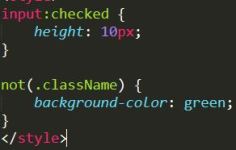
Pseudo-Classes are the ones which sub-categorize the elements belong to a same category ( i.e., Selector) based on the state of the elements or position of the elements or other properties like :not, :required, :checked etc. Pseudo-Classes are the ones which are identified by semicolon, so you will notice that there will be a semicolon( : ) in front of each pseudo-class.

pseudoClassesNew

If we do deeper in pseudo-classes based on state of elements, there are :link, :visited, :hover, :active and the order of these classes(LVHA) is important because there are properties common in all the 4 classes and will not work as expected if we change the order. (take a basic element and write CSS with these 4 elements and try changing the order and see what happens)

Pseudo-Elements are the ones which goes much deeper in categorizing the elements belong to a same category( i.e., Selector) and this allows to style part of an element like ::first-line, ::first-letter, ::selection or even adding a content ::before or ::after an element. Pseudo-Elements are identified by double semicolon, so you will notice that there will be a double semicolon( :: ) in front of each pseudo-class. (This was : in CSS1 and CSS2)

pseudoElements

Keep it Simple- 2: Pass By Reference Vs Pass By Value

Pass By Reference Vs Pass By Value, which of these two JavaScript follows? Well JS is pretty good at handling both the pass by reference and pass by value. Let’s look into the basic definition of both the methods first and then dig into How JS uses these methods.

Pass By Reference: Imagine, you and your friend are on a same boat and you want to reach somewhere, if the boat has reached the other end of the river then both you and your friend will also been reached. So, one’s status is affecting other’s status.

xophcjaathopsououswi

Pass By Value:  Here each will be sailing in their own boats, so if one boat has reached the other end of the river, it doesn’t mean that other boats had also reached the end. So, here one boat is independent on other boats.  31863404-Иллюстрация-Благодаря-kids-пробуя-различные-водные-виды-спорта

How JavaScript is handling both the methods?

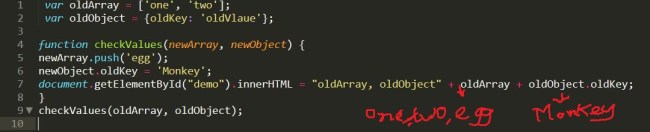
JS follows pass by reference  in case of objects and arrays i.e., if they are passed to a function and the values inside the function are assigned to a new value then it does affects the original value as well.

passByRef

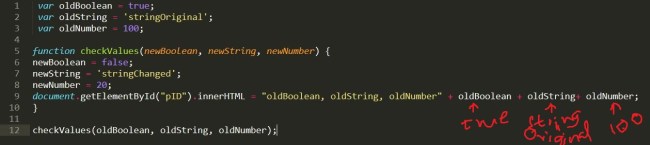
It follows pass by value in case of variables like  boolean, string, number i.e., if they are passed to a function and the values inside the function are assigned to a new variable then it doesn’t going to affect the original value.passByValue

Keep It Simple -1: Five Simple Facts of Sort() in VanillaJS

It is always a good idea to get a strong knowledge on basics. We have many ways to sort elements in most of the JavaScript frameworks in angularJS, react JS etc., here lets see how it is done in Plain/VanillaJS.

In JavaScript, sort() always tries to put elements in ascending or alphabetical order if none specified. Here are 5 basic and simple facts about sort() in plain JavaScript-

  1. It sorts the elements with same special characters as expected
    Ex: [‘$5’, ‘$1’, ‘$2’] gives $1, $2, $5 
  2. When same element with different characters are in array then it sorts according to the special char but not based on the digits.
    Ex: [ ‘$3’, ‘*4′,’@1’, ‘&2’] gives $3, &2, *4, @1
  3. It doesn’t sort elements with different number of digits.
    Ex: [1,2,10,3] gives 1,10,2,3
  4. When an empty string is involved with numbers and alphabets, it always puts the empty string at first, then numbers will be sorted in ascending order and then strings will sorted alphabetically.
    Ex: [‘bananas’, ‘apple’, ”,1, 5] gives  ,1,5,apple,banana
  5. If an array has negative numbers involved with positive numbers, it just considers negative numbers together and tries to sort them ascending without considering ‘-‘ and then sorts positive numbers.
    Ex: [1, -15, -1, -3, 2, -2] gives  -1,-15,-2,-3,1,2

Angular Directives and its Scope

Directive, what is the purpose of having a directive in our code?

For instance, I want a Vehicle to travel and I have all the parts required for that like tiers, bolts, body and other needed material, so I would just assemble them and use it whenever I need. Else it is a nightmare to assemble the car each time I need to go out.  Similarly, I have a functionality bound within a directive and reuse it wherever I need it in my application like  Angular builtin directives ng-bind, ng-init, ng-app and many more.

Angular also allows to create our own directives with any name we like. So we can have a custom directive with a scope variable, however it is optional to define scope inside a directive. If we skip mentioning scope, it gets default with false. There are mainly 4 ways to define scope of the directive-

a) scope: false

It just shares the scope with controller, that is when a change made in directive, it reflects in controller and other directives as well.

Example: Close friend, who shares everything.

b) scope: true

It inherits the scope from controller acting as its child, that is a change in directive, do not reflect in controller or other directives.

Example: greedy friend, who do not want to give his stuff to others but would take from them.

c) scope: {}

This is known as isolated scope, which completely isolates scope from its parent directive, and do not inherit anything from parent and do not share anything out as well.

Example: Real quite friend, who do not take or give from others.

d) scope: { var1: ‘=’,    var2: ‘&’,   var3: ‘@’,   callVar4: ‘&dirVar4’ } 

This is the best practice of all, which helps us to choose what variables should be visible to outer world and what not. In this case, only the variables or functions that are mentioned within { } are allowed to communicate with controller and changes for these variables made in directive will reflect in controller and other directives as well.

Example: Work Friends, who shares stuff that are important to work but not random unnecessary stuff.

var1: ‘=’ – It allows two way binding for scope variables,

var2:’@’  – It is for string variables

var3:’&’ – for accessing methods that are in controller

callVar4:’&dirVar4′ –  same as above method but for giving new name for method in controller.

This is very vast subject to discuss but above details give a precise knowledge required to dive into the details of directives and scopes.

Angular Way to $watch HTML Forms using $pristine

So, I have an HTML form and whenever there is a change in it I want to perform an action, there are two ways to do the monitoring in Angular-

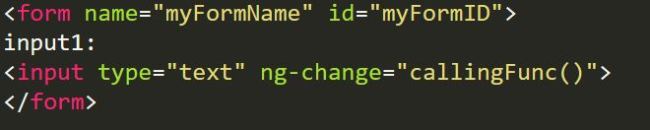
a) Using ng-change in the input fields and calling the function to perform if form changes.

This way is pretty easy and that’s okay when there are like 5 input fields in a form, all we need to do is to put ng-change in each field. But what if there are 100 input fields in a form, it is takes heck lot of time to put ng-change for each of the 100 input fields. So, it is good only for less number of fields not for more.

ngchange

b) Using $watch in the controller, to check for the form changes using $pristine in the form. 

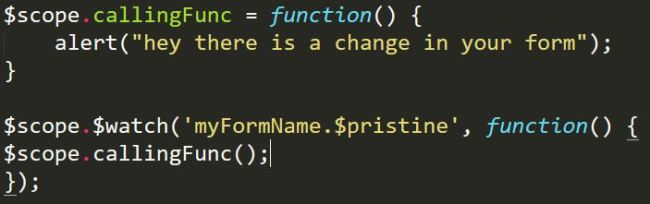
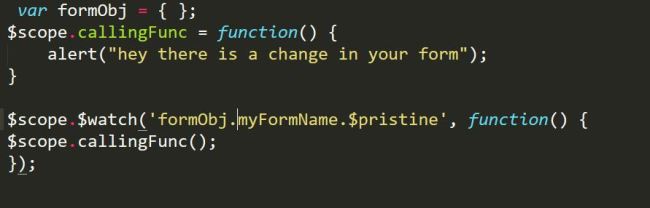
The $watch way is my favorite, all you need to do is to use a simple $watch in the controller in order to detect the changes in it. Here is the way to do it,

Lets take the same above example and take off the ng-change from it, your controller should look like something below –

watchingforms

But this wouldn’t work, why everything seems to be right?   The above code has a mistake, what is it? So for example, I came from a place where there is a local famous guy called – “Sid Smith” and I went to my friends place to attend a party, there I have been taking Sid Smith’s name constantly and my friends were able to relate to this guy called Sid but not the strangers. So there should always need to be local reference in order to able to make a conversation.

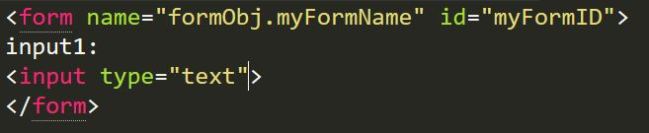
Here we had similar situation, we need make a local reference in controller in order to understand which form is it, all we need to do for that is create an empty object in controller.


correctform

and the HTML should look like below –

corectformhtml

That’s all, here the watch is checking form constantly if the form is $pristine or no and calls the function whenever there is a change in the form.

Now you know, NPM – Node Package Manager

So, I always used to wonder in my early stages of using NodeJS, why I hear alot of npm whenever I hear about NodeJS? As I dig into the details of npm with NodeJS, I found that it is so important for every JavaScript programmer who works in groups.

But how does that help?  npm has been a time savior for many JavaScript programmers by not letting them to replicate their work, as it allows them to share a piece of code between them in the means of package. So, the piece of code that can be shared is called as package/module.

All the basic details you might have to know about NPM:

  1. The code can be shared with the team by writing the code in a file with .js extension, example: random_name.js
  2. Once a developer shares the package with his team, his teammates can also check for the new versions on the package.
  3. The meta data of the package can be included in a .json file, typically called as package.json file.
  4. A package can be installed locally or globally. Typically one installs globally (tags with -g to regular commands) when it is used outside the project you are currently in like command line. When you want to use it within your project then it should be installed locally and can be accessed in the file by mentioning in require(‘package_name’)
  5. One can uninstall a package from the node_modules at any time if the package is no longer needed.

What is package.json:

  • package.json is a file which can be used to install the packages with a command npm install. 
  • The attributes are name, version, dependencies, devDependencies, author, contributors and many other.
  • name: package name
  • version: package version (if ^ is included in front of it then it looks for equal or greater than the current version)
  • dependencies: any dependencies with the package can be added.
  • devDependencies: the dependencies which are useful only in develop and testing environments can be added here, like testing tools etc.
  • author: creator of the package.
  • Other way to add dependencies is by using –save in command line. Syntax would look like, npm install <package_name> –save

General npm commands:

  • npm ls: To see all the packages (-g for global packages)
  • npm init: To start a package.json file
  • npm update: To update all the packages
  • npm install <package-name>: To install a particular package (npm install -g <package-name> for global packages)
  • npm install: To install all the latest version of packages listed in the dependencies
  • npm install <package-name> –save: To add dependencies in command line
  • npm config set prefix ‘~/.xxx’ : To configure npm teh prefix (the directory)
  • npm get prefix:  To know the location where it has been stored.
  • npm outdated: To see all the version updates on the packages.
  • npm search <pakage_name> : To search a package
  • npm uninstall <package_name>: To uninstall a package (add –save to remove completely from the dependencies)

Simple overview of AngularJS $watch

AngularJS is being widely used these days, it is used to do in-numerous number of tasks, it is hard for it to keep track of all the elements, so it has to get a way to let few particular elements that needs to be tracked for changes. So Angular has watchers to keep track of all elements that needs to be tracked down, these elements can either be variables, objects, outputs of a functions etc but how to know which ones are to be tracked and which one’s not, this can be done either by using {{varname}} or by associating  the variable with $watch .

Syntax: $scope.$watch(watchExpression, listener);

a)  Where  watchExpression is the expression that needs to be watched, this can be an array or object or function.

b) listener is a function that would be called whenever there is a change in the expression. The listener can be of two types-

i) It can be just a function that have no parameters, this can be

ii) It can have parameters that needs to be compared with a new variable that is created like – syntax:  function(newVar, oldVar)

Examples:

1) When we have a bunch of pink flowers in a vase, we usually check the freshness of flowers from time to time and change the flowers when they have started fading out the color.

angularwatch1

Here, flowers are the watchExpression  and the act of changing flowers is the listener, whenever there is  a change in flowerColor, the changeFlower() is called.

2) When we go to pick Chrysanthemums, we pluck them when they have come for blossom but not in the bud.

angularwatch2

In the above example, blossom is the “new value” and bud is the “old value” of the flowerStage variable, so when flowerstage has been moved from bud to blossom, we perform the action of pluckFlower()

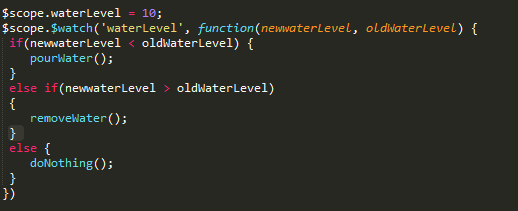
3) When there is a pot of water for certain level let’s say at 10, if the level of water goes down due to sun or any other reason we need to water it else if the level of water goes up we need to take out the extra water. This can be done as follows-

waterlevel

ng-class conditional assignments in detail in AngularJS

ng-class is a directive that allows one to setting class/classes on an HTML element based on an expression evaluation. This ng-class directive can also be represented as ngClass (camel case).

These expressions can either be an object({}) or a string or an array ([])

There are various types of class assignments based on the conditions we give to evaluate, lets see few of the ways to do so-

  1. Simple class assignment:   ng-class=”classname”
  2. Simple array assignment:   ng-class=”[class1, class2, class3]’
  3. Simple object assignment: ng-class=”{classname: value}”

So, now lets see how to assign conditional classes:

  1. Single condition assignment: Here, we assign a class if a name equals to a value then it meets a condition.
      Syntax: ng-class=”{classname: name==’value’}”
    For example, if a child chooses chocolate color then he must go to  brown class and it is represented as below-
    Example Syntax:  ng-class=”{ brown: child == ‘chocolate’}”
  2. Multiple condition assignment:

          a) Here, we check for a condition for name, if it equals to value1 then class1 is assigned else if it is equal to value2 then it gets assigned to                           class2.
Syntax:
ng-class=”{class1: name==’value1′,  class2: name==’value2′, }”
For example, if a child chooses chocolate color then he must go to  brown class and if he chooses strawberry then he must go to pink class,                    it is represented as below-
Example Syntax:  ng-class=”{ brown: child == ‘chocolate’, pink: child == ‘strawberry’}”

          b) Here,we check for a condition for [name], if it equals to value1 then class1 is assigned else if it is equal to value2 then it gets assigned to                       class2.
Syntax:  
ng-class=”{value1: ‘class1’, value2: ‘class2’, }[name]”
For example, if a child chooses chocolate color then he must go to  brown class and if he chooses strawberry then he must go to pink class,                    it is represented as below-
Example Syntax:  ng-class=”{chocolate: ‘brown’, strawberry: ‘pink’, }[child]”

          c) Here, we check for a condition for [name] if it equals to value1 then class1 is assigned else then it gets assigned to class2.
Syntax:  
ng-class=”{true: ‘class1’, false: ‘class2’, }[name == value1]”
For example, if a child chooses chocolate color then he must go to  brown class else he must go to pink class, it is represented as below-
Example Syntax:  ng-class=”{true: ‘brown’, false: ‘pink’, }[child== ‘chocolate’]”

          d) Here, we check for a condition for [name] if it equals to value1 then class1 is assigned else then it gets assigned to class2. (? is equivalent to ‘if’ and : is equivalent to ‘else’)
Syntax:  
ng-class=”name == ‘value’ ? ‘class1’: ‘class2’”
For example, if a child chooses chocolate color then he must go to  brown class else he must go to pink class, it is represented as below-
Example Syntax: ng-class=”child== ‘chocolate’ ? ‘brown’: ‘pink’”

Promise in AngularJS

Promise: It is an interface for interacting with an object that represents the result of an action that is performed asynchronously, and may or may not be finished at any given point in time.

According to the AngularJS’s standard API Reference documentation,  promise API is to asynchronous programming what try, catch and throw keywords are to synchronous programming. So, it is basically meant for better error handling.

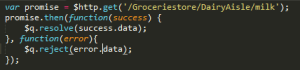
Let’s make it Simple and Short, the Promise basically makes use of a $q which is a service in ng module. So there are totally two possibilities for the Promise, it can be resolved  and rejected. The resolved/rejected promise will get back the data/error that needs to be used by a function in the controller. So basically the practical use of  a promise is to make asynchronous possible.

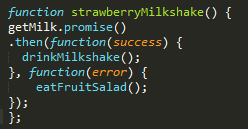
Angular implements promise by using .then() function, which takes two functions as arguments, the former is for success and the later is for error (sometimes optionally it takes notify() as an arguments). This can be illustrated by simple real time example as below-

Let us take a scenario that there are two friends who wants to make strawberry milkshake and they have strawberries, cream and honey ready but when they look into their refrigerator they found that they are out of milk.

So, one of the friends promise the other that he would get the milk from the grocery store, while the other friend would not sit idle while he waits for his friend to get the milk, instead he asynchronously would slice the strawberries and make all the arrangements necessary for making the strawberry milkshake.

Now, there are two possibilities for the promise made by one of the friends – it can be  resolved or rejectedIf there is milk available at the grocery store and he can get it to his friend who is at home then the promise has been resolved and if for some reason he could not get the milk and returns empty hand then it means that the promise has been rejected.  And this function uses getMilk() service provided by the other friend.

MilkshakeNew

So here, if the promise has been resolved, the friends implement drinkMilkshake() else if the promise has been rejected they just eat fruit salad by implementing eatFruitSalad() method.

The promise in the getMilk() service looks like below –

milkNew

References:

http://wiki.commonjs.org/wiki/Promises

https://docs.angularjs.org/api/ng/service/$q